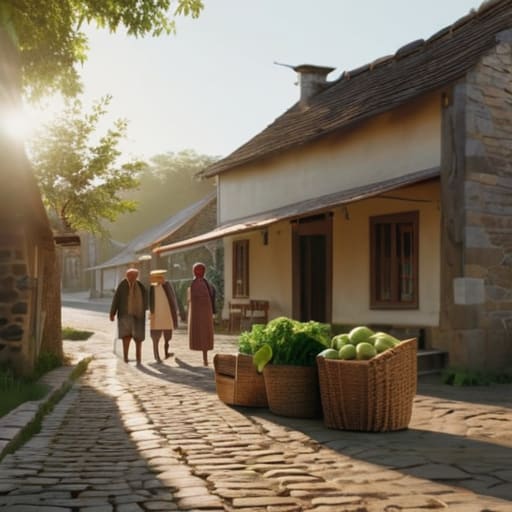
You’ll hear plenty of talk from people in suits about “social cohesion” and “sustainable development” when they’re trying to explain how rural communities function, but most of it is just expensive noise. They look at a map and see dots on a grid; they don’t see the reality of a village where the only thing keeping the lights on is a shared understanding of who has the working tractor when the frost hits in January. A community isn’t some theoretical concept you can fix with a government grant or a new community centre; it’s a delicate web of debts, favors, and shared hardship that holds steady only as long as the local economy has enough blood in it to circulate.
I’m not here to give you a lecture on sociology. I’m going to tell you how this actually works when the weather turns and the margins get thin. We’ll look at the practical mechanics—from the way a local auction mart dictates the mood of a whole parish, to why the survival of the village school is more tied to livestock prices than any social policy. I’ve made enough mistakes to know that if you don’t respect the economic bones of a place, the social skin will peel right off.
Table of Contents
- Social Capital in Rural Areas the Real Glue That Holds Us Together
- How Rural Communities Function Beyond the Post Office and Pub
- Rural Social Networks Why Your Neighbors Are Your Best Insurance
- Local Governance and Infrastructure Avoiding the Expensive Mistakes of Negl
- Rural Economic Development and the Brutal Impact of Urbanization
- Five Hard Truths About Keeping a Community From Folding
- The Bottom Line: What Actually Keeps a Village Standing
- The Bottom Line
- Frequently Asked Questions
Social Capital in Rural Areas the Real Glue That Holds Us Together
You can talk all you like about subsidies and broadband speeds, but if you want to know why a village survives a hard winter or a sudden dip in beef prices, you look at the people. It isn’t about fancy policy papers; it’s about the rural social networks that exist long before anyone thinks to write them down. It’s the bloke three gates down who shows up with a tractor when your calf is stuck in the muck at three in the morning, not because he’s being paid, but because he knows it’ll be him next Tuesday. That’s the real glue.
Most folks coming from the cities think a community is just a collection of houses, but out here, it’s a web of mutual debt and unspoken agreements. We call it community resilience strategies in the textbooks, but on the ground, it’s just knowing who has the working welder and who has the extra hay when the silage crop fails. If you lose that trust, you lose the farm, regardless of how much land you’re sitting on.
How Rural Communities Function Beyond the Post Office and Pub
People like to talk about the village pub or the local post office as if they are the sole lungs of a community, but that’s a surface-level view. If you want to see how a place actually breathes, you look at the informal networks that kick in when the weather turns or a tractor breaks down in a bottom field. It’s the neighbor who notices your gate is unlatched, or the person who shows up with a trailer before you’ve even had the chance to ask. These rural social networks are the invisible scaffolding; they aren’t written into any government white paper, but they are the only reason most of us make it through a hard winter.
True resilience isn’t found in a shiny new community center, though those have their place. It’s found in the way we share information—who’s selling what, which vet is actually worth the call-out fee, and which tracks are too boggy for the heavy machinery. When we talk about community resilience strategies, we shouldn’t be looking at grand schemes, but at the strength of these everyday handshakes. It’s about the quiet, unrecorded transactions of time and labor that keep a parish from drifting apart.
Rural Social Networks Why Your Neighbors Are Your Best Insurance
You can buy all the fancy insurance policies in the world, but they won’t help you when a blizzard hits at three in the morning or when a gate latch snaps on a field full of hungry ewes. In this business, your real safety net isn’t a piece of paper from an office in the city; it’s the man three gates down who knows exactly which tractor has the right weight for your soil. These rural social networks are the only thing that actually keeps the wheels turning when the weather turns foul or the supply chain breaks.
It’s a practical kind of security. We trade favors, we share machinery, and we keep an eye on each other’s stock. That isn’t just being neighborly; it’s a fundamental part of community resilience strategies that keeps us solvent. When the local shop closes or the school shrinks, you feel the fraying of that fabric immediately. You realize that once that connection to the person next to you is gone, you aren’t just losing a friend—you’re losing a vital layer of your own operational security.
Local Governance and Infrastructure Avoiding the Expensive Mistakes of Negl
The problem with most talk regarding local governance and infrastructure is that it’s usually handled by people who think a “road” is something you drive on to get to a supermarket, not something that has to survive a heavy tractor in a wet February. When the council decides to trim the maintenance budget, they aren’t just cutting costs; they are cutting into our ability to move stock and get goods to market. If the single-track lane leading out of the valley turns into a bog because the drainage hasn’t been cleared since the last administration, it doesn’t matter how much rural economic development grant money is floating around in a spreadsheet in the city. You can’t build an economy on ground you can’t traverse.
Neglect is a slow leak, not a sudden burst. It starts with a closed library or a diverted bus route, and it ends with the young ones realizing they can’t live here without a car they can’t afford to fuel. We talk a lot about community resilience strategies, but resilience isn’t just about having a good neighbor to borrow a quad from; it’s about having the basic, boring bones of a working landscape—reliable power, decent broadband, and roads that don’t swallow a trailer whole.
Rural Economic Development and the Brutal Impact of Urbanization
You see it every time you drive into the next valley: the old machinery shop turned into a boutique coffee house, or the feed store replaced by a holiday let. People call it “diversification,” but if you look at the ledger, it’s often just a slow leak. When the core industries—the ones that actually require people to live, work, and sweat in the mud—start to thin out, the whole structure shifts. The impact of urbanization on rural life isn’t always a sudden flood; it’s more like a steady drought that dries up the local supply chain. When the young people head for the cities because they can’t see a future in a landscape of part-time holiday homes, you lose the very hands needed to maintain the local economy.
Real rural economic development isn’t about attracting a tourist trail; it’s about ensuring a man can make a living from his land and still have a reason to spend his money in the village. If the local garage closes because everyone is driving electric commuters from the city, the village loses a bit more of its backbone. You can’t build community resilience strategies on a foundation of seasonal visitors who don’t care if the drainage fails or the local school closes. You need people with skin in the game.
Five Hard Truths About Keeping a Community From Folding
- Don’t mistake a village hall for a community; a community is the informal network that decides who gets a hand with the harvest when the tractor breaks or who checks on the widow down the lane when the snow is deep. If those unwritten rules stop working, the buildings won’t matter much.
- Watch your local services like you watch your calving rates. Once the last shop or the last school closes, the demographic shifts, the young folk head for the cities, and you’re left with a beautiful landscape inhabited by nothing but retirees and holiday rentals.
- Invest in the people, not just the infrastructure. A new community center is just a way to store dust if you haven’t got the local characters and the reliable hands willing to run the committees and show up to the meetings.
- Understand that local governance isn’t just about planning permissions; it’s about the grit required to fight for the roads and the broadband that actually work. If you don’t have a seat at the table, you’re just part of the menu.
- Keep your eyes on the economic diversity. A community that relies on a single employer or one specific subsidy is as vulnerable as a field with no drainage; when the rain comes or the market shifts, the whole thing washes away.
The Bottom Line: What Actually Keeps a Village Standing
A community is only as resilient as its local economy; when you lose the small-scale service providers to urban sprawl, you aren’t just losing shops, you’re losing the social fabric that catches people when they fall.
Don’t mistake a busy pub for a healthy community; true social capital is found in the informal networks—the neighbor who checks the stock when your tractor breaks or the person who notices a gate left open.
Infrastructure isn’t just about tarmac and broadband; it’s about maintaining the local institutions that allow a rural area to function as a self-sustaining unit rather than a mere dormitory for the nearest town.
The Bottom Line
If you take anything away from this, let it be that a rural community isn’t just a collection of postcodes or a map of farm boundaries; it is a living, breathing system of mutual reliance. We’ve looked at how social capital acts as our safety net, how our local networks serve as a better insurance policy than any premium you’ll find in a city office, and how the slow erosion of our infrastructure can bleed a district dry just as surely as a bad year of prices. It all comes back to the same principle I apply to my herd: if you ignore the foundation—the grass, the feet, and the cash flow—the whole structure eventually collapses under its own weight.
Looking ahead, the challenge isn’t going to be found in a government white paper or a new subsidy scheme, but in how we choose to show up for one another when the weather turns or the markets dip. We cannot wait for urban planners to understand the nuances of life on the margins; we have to be the ones to guard our own gates. It’s about making sure the next generation doesn’t just inherit a set of hectares, but a community that is actually worth staying for. Keep your eyes on the ground, your hands on the levers, and never underestimate the value of a neighbor who knows exactly what it costs to keep a farm running.
Frequently Asked Questions
If the social glue is all well and good, how do we stop the younger generation from moving away the second they get their certificates?
You can’t keep them here with sentiment or “community spirit” alone. If the numbers don’t work, they’ll leave, and they’re smart enough to know it. You have to make the business viable enough that staying isn’t a sacrifice of their future. That means better connectivity, realistic succession planning, and moving away from the idea that farming is just hard work for diminishing returns. If they can’t see a path to a decent life, they’ll find one elsewhere.
We talk about neighbors being insurance, but what happens to a community when the local businesses are bought out by people who don't actually live here?
It’s like buying a prize heifer that looks grand from the road but’s got nothing in her tank. When a local shop or garage is bought by someone living three counties away, the profit leaks out of the parish like water through bad limestone. They don’t care about the local harvest or who’s had a bad season; they just care about the spreadsheet. You lose the credit, you lose the custom, and eventually, you lose the community.
How do we balance keeping the traditional way of life going without letting the whole place turn into a museum for tourists?
You can’t freeze a farm in amber and expect it to breathe. If we only cater to the people coming in for the scenery, we’ll end up with a village of gift shops and holiday lets, and no one left to actually work the land. The balance is simple, though not easy: keep the businesses that serve the people living here, not just the ones passing through. If the young ones can’t afford a house or a decent wage, the museum wins.
